
Building Autonomous AI Agents: From Reactive Prompting to Multi-Agent Architectures
The artificial intelligence landscape is undergoing a fundamental paradigm shift. For several years, human interaction with Large Language Models (LLMs) was strictly reactive and chat-based: a human prompt yields a single, isolated response. While powerful for drafting text or answering queries, this model is inherently constrained by human latency and manual orchestration.
Enter Autonomous AI Agents: software entities capable of perceiving their environment, breaking down high-level objectives into sequential sub-tasks, executing tools, calling external APIs, and iteratively correcting their own errors without direct human intervention. Moving beyond static prompts toward dynamic agentic workflows transforms generative models from smart lookup engines into active digital workers.
Anatomy of an Agent: Core Structural Pillars
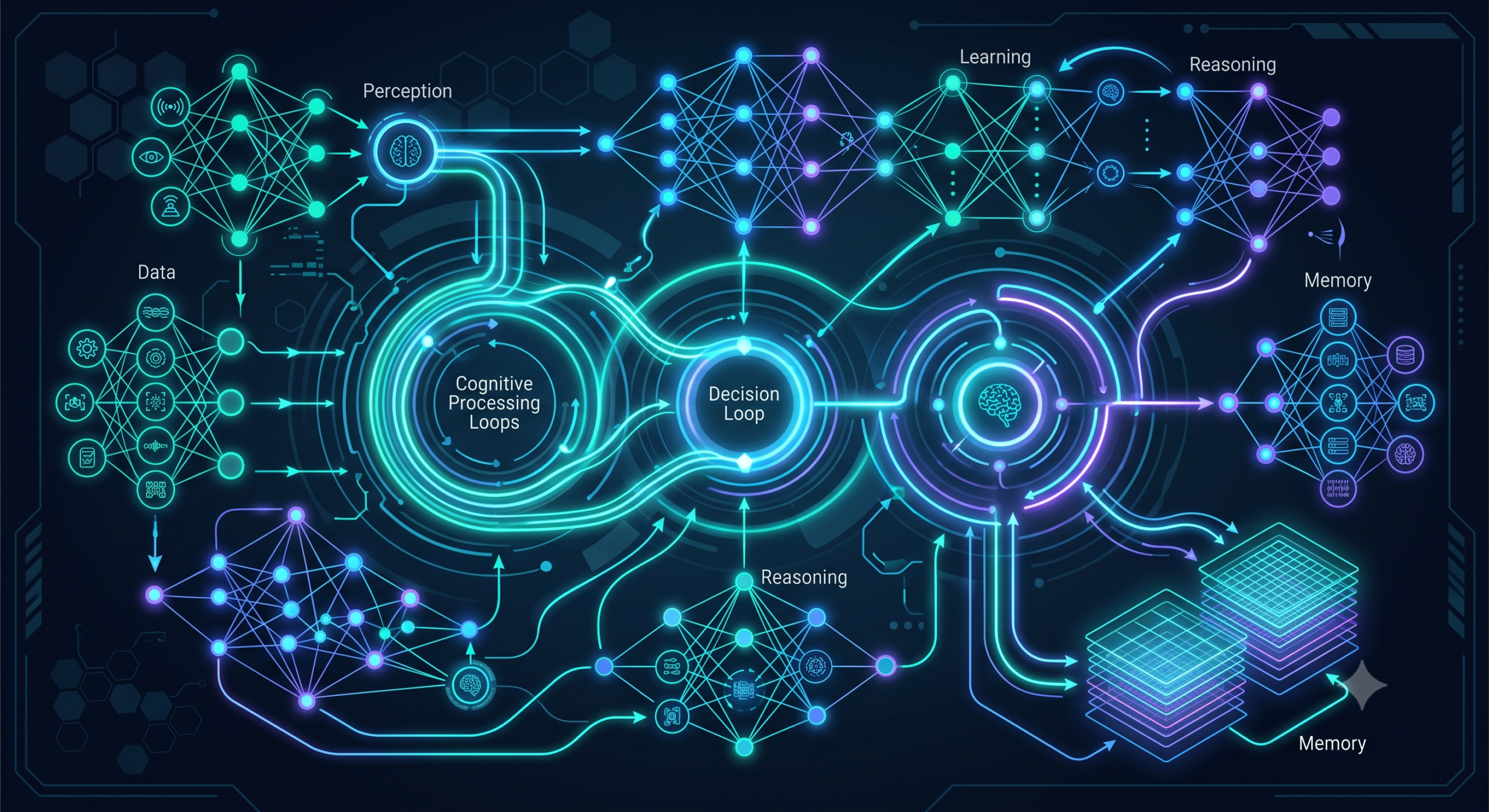
To construct a robust autonomous agent, developers must integrate four foundational cognitive components:
-
Memory Management (Short-Term vs. Long-Term):
-
Short-Term Memory: Managed via the model’s context window, keeping track of current conversation states and task variables.
-
Long-Term Memory: Enabled by Vector Databases (e.g., Pinecone, Qdrant, Chroma). By storing semantic embeddings of previous actions, user preferences, and enterprise documentation, agents retrieve relevant context dynamically via Retrieval-Augmented Generation (RAG).
-
-
Planning & Task Decomposition:
-
Complex goals like “Build a data pipeline for user analytics” cannot be solved in a single inference call. Agents utilize techniques such as Chain-of-Thought (CoT) and Tree-of-Thoughts (ToT) to decompose macro-goals into actionable, micro-step DAGs (Directed Acyclic Graphs).
-
-
Tool Usage (Function Calling):
-
Agents achieve agency by executing real-world tools. Through standardized JSON schemas, LLMs select and execute external endpoints—such as querying SQL databases, making web searches, invoking REST APIs, or running code in isolated sandboxes.
-
-
Reflection & Self-Correction:
-
Advanced agent frameworks incorporate self-critique loops (e.g., ReAct framework: Reasoning + Acting). If a Python script generated by the agent throws an execution error, the error output is fed back into the context, prompting the agent to debug its own code autonomously before presenting the result.
-
Single-Agent vs. Multi-Agent Systems
While a single agent managing memory and function calls works well for narrow workflows, complex enterprise projects require collaborative orchestration across multiple specialized agents.
+-----------------------------------------------------------------------+
|                           USER REQUEST                                |
+-----------------------------------------------------------------------+
                                    |
                                    v
+-----------------------------------------------------------------------+
|                   ORCHESTRATOR / MANAGER AGENT                         |
|           Decomposes task, routes context, monitors state             |
+-----------------------------------------------------------------------+
            /                       |                       \
           /                        |                        \
          v                         v                         v
+-------------------+     +-------------------+     +-------------------+
|  RESEARCH AGENT   |     |   CODER AGENT     |     |    QA AUDITOR     |
| Fetches APIs &    | --> | Writes modular    | --> | Executes unit     |
| documentation     |     | source code       |     | tests & benchmarks|
+-------------------+     +-------------------+     +-------------------+
-
The Orchestration Layer: A manager agent receives user goals and delegates tasks to domain-specific sub-agents.
-
Specialization: Rather than using one prompt to handle research, coding, and quality control, individual agents are assigned distinct roles, system prompts, and tool sets.
-
Consensus & Evaluation: Agents cross-verify work. For instance, a Coder Agent generates a function, a Security Agent scans it for vulnerabilities, and a QA Agent writes unit tests.
Architectural Implementation Blueprint
Implementing an agent framework programmatically involves structured loops using tools like LangGraph, AutoGen, or CrewAI. Below is a conceptual implementation of an iterative execution loop:
Python
class AutonomousAgent:
    def __init__(self, role, memory_db, tools):
        self.role = role
        self.memory = memory_db
        self.tools = tools

    def execute_task(self, goal):
        plan = self.decompose_goal(goal)
        for step in plan:
            status = False
            retries = 0
            while not status and retries < 3:
                result = self.run_tool(step.tool_name, step.params)
                status = self.reflect_and_verify(step, result)
                if not status:
                    retries += 1
                    step.params = self.debug_plan(step, result)
        return "Task Completed Successfully"
Technical Challenges & Production Safeguards
Deploying agentic systems into production introduces unique engineering hurdles:
-
Infinite Execution Loops: Agents can become trapped in non-terminating loops when encountering unhandled API exceptions. Systems require strict execution limits, depth caps, and timeout constraints.
-
Prompt Injection & Tool Security: Providing agents write access to databases or terminal environments opens attack vectors. Sandbox environments (e.g., Docker containers, eBPF isolation) and human-in-the-loop (HITL) approval layers are mandatory for destructive commands.
-
Context Drift and Token Cost: Multi-turn autonomous loops consume high token volumes. Developers must implement aggressive context-pruning algorithms and cache deterministic responses.
Conclusion
Autonomous agents represent the next evolution in software engineering, shifting human input from micromanaging syntax to orchestrating high-level systems. Integrating multi-agent architectures into enterprise pipelines will define the next decade of software automation.
