
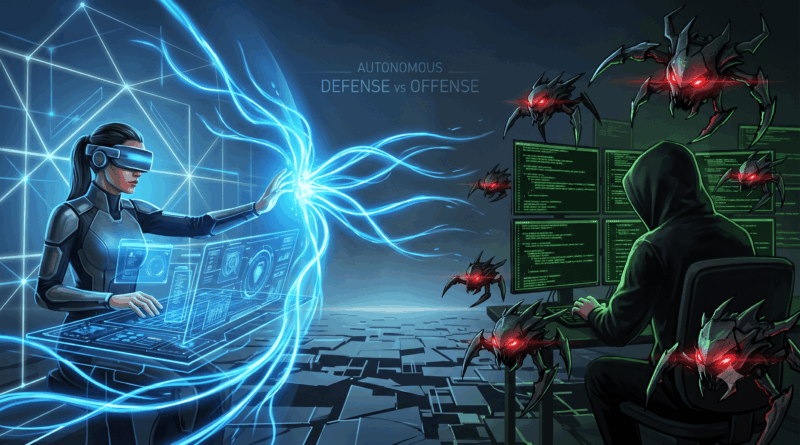
Agentic AI in Offensive and Defensive Cyber Warfare
The Paradigm Shift from Rules to Autonomous Decision-Making
For decades, cybersecurity operated on deterministic rules: if signature $A$ appears on port $B$, flag alert $C$. Even early machine learning implementations were largely static, acting as glorified statistical classifiers that relied on historical training datasets to flag anomalous behavior. The shift toward agentic artificial intelligence represents a fundamental departure from this reactive framework.
Unlike passive generative AI models that merely respond to prompts with static text or code snippets, agentic AI systems possess agency. They break down open-ended goals into structured execution steps, evaluate environment states continuously, adapt their actions dynamically based on environmental feedback, and execute multi-step operations without requiring intervening human approval. In enterprise environments, this evolution converts security software from a passive monitoring tool into an active digital colleague. In the hands of malicious threat actors, however, agentic AI functions as a fully automated adversary capable of conducting multi-stage cyber campaigns at machine speed.
The Offensive Machine: Autonomous Threat Orchestration
Historically, human penetration testers and nation-state threat actors were bound by a major constraint: cognitive bandwidth. Executing a successful advanced persistent threat (APT) campaign required human operators to manually probe firewalls, analyze exposed service binaries for zero-day vulnerabilities, construct custom exploitation payloads, pivot through compromised internal subnets, and locate high-value data repositories.
Agentic AI eliminates this operational bottleneck. Modern autonomous attack agents are built on multi-agent frameworks where specialized models collaborate to execute malicious workflows:
-
Reconnaissance Agents: These bots continuously monitor public IPv4 and IPv6 address spaces, web applications, and cloud storage buckets. They don’t just log open ports; they actively analyze API endpoints, evaluate server headers, and test input fields for subtle edge-case behavior.
-
Exploit Synthesizers: When a potential memory corruption, logic bug, or authentication flaw is detected, a dedicated vulnerability agent autonomously parses the target application’s compiled code or public repositories. It drafts, compiles, and tests exploit payloads in isolated runtime containers, iterating until a working exploit is confirmed.
-
Lateral Movement Agents: Once inside an enterprise network perimeter, autonomous agents evaluate directory services (such as Active Directory or LDAP), analyze local credential caches, map trust relationships between cloud subnets, and execute privilege escalation routines.
Crucially, offensive agents act with context-aware stealth. If a network security monitoring platform flags a rapid sequence of connection requests, an offensive agent recognizes the defensive response in real time, throttles its traffic, rotates its source IP addresses across decentralized proxy networks, and switches to passive memory-only techniques to avoid endpoint detection and response (EDR) agents.
The Defensive Counter-Strategy: AI-Driven Security Operations Centers (SOCs)
Defending against an automated adversary with static security rules is mathematically impossible; human analysts cannot process thousands of complex security events per second. Defensive security operations are pivoting to autonomous SOC platforms powered by agentic defense systems.
Modern defensive agents operate within unified Security Information and Event Management (SIEM) and Extended Detection and Response (XDR) architectures. When anomalous telemetry is ingested—such as an unusual PowerShell execution combined with an unexpected cloud API token creation—defensive agents launch parallel investigations:
-
Contextual Data Gathering: A triage agent automatically queries active directory records, cross-references recent user login locations, pulls network flow logs, and fetches file hash reputations from global threat intelligence feeds.
-
Hypothesis Generation and Verification: The defensive agent constructs alternative hypotheses (e.g., “authorized administrator performing routine maintenance” versus “credential theft and active exfiltration”). It tests these hypotheses by analyzing process lineage trees and system event logs.
-
Autonomous Remediation: If the risk score breaches predefined organizational thresholds, the defensive agent executes immediate containment steps without waiting for a tier-1 SOC analyst: revoking compromising OAuth tokens, isolating the affected endpoint from the virtual private cloud (VPC), blocking malicious command-and-control (C2) domains on edge firewalls, and generating forensic memory dumps.
By handling low-to-medium complexity incidents autonomously, defensive agents reduce mean time to detect (MTTD) and mean time to respond (MTTR) from hours down to milliseconds, allowing human security teams to focus exclusively on strategic risk management and threat hunting.
The Governance and Safety Horizon
The widespread deployment of agentic AI introduces novel attack vectors that security architectures must address. Indirect prompt injection attacks allow malicious actors to embed hidden instructions inside untrusted data files, emails, or web pages. When a defensive AI agent processes these corrupted inputs during incident triage, the embedded instructions can hijack the agent’s logic, coercing it to delete audit logs or expose sensitive API keys.
Establishing robust guardrails requires strict enforcement of the Principle of Least Privilege for AI. AI agents must operate within sandboxed runtime environments with hard-coded authorization boundaries. Deterministic security rules must override agent decisions when high-risk actions (such as dropping critical database schemas or modifying root domain permissions) are requested. The future of cyber defense relies not on trusting AI implicitly, but on verifying its operational boundaries through continuous validation frameworks.
