
Identity-First Zero Trust Architecture: Beyond the Traditional Perimeter
Introduction: The Collapse of Network-Based Security
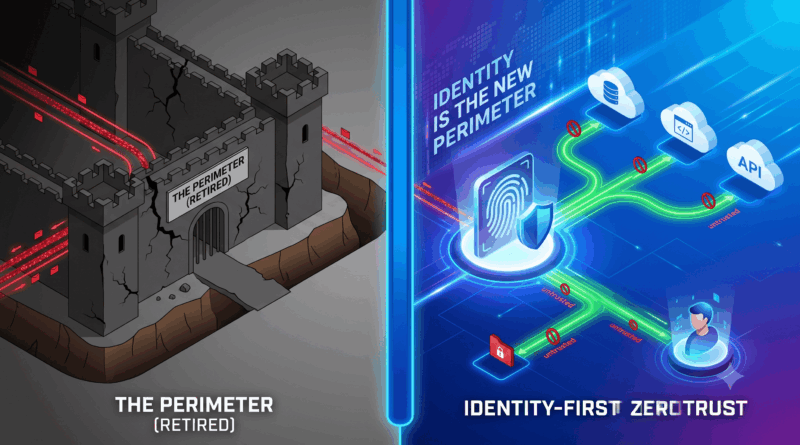
For decades, corporate IT infrastructure relied on the “castle-and-moat” security architecture. Organizations drew a rigid line around their physical networks using perimeter firewalls, Virtual Private Networks (VPNs), and intrusion prevention systems. Everything inside the network boundary was deemed trusted, while everything outside was treated as hostile.
The mass adoption of cloud services, hybrid work models, third-party microservice APIs, and edge computing has rendered this physical boundary obsolete. The modern corporate perimeter no longer resides in a physical server rack; it spans thousands of employee laptops, mobile devices, SaaS platforms, and distributed cloud workloads. Once an attacker breaches a perimeter legacy VPN via compromised credentials or software vulnerabilities, they gain unrestricted lateral access across the flat internal network.
Identity-First Zero Trust Architecture fundamentally restructures this paradigm. Guided by the core directive—“Never Trust, Always Verify”—Zero Trust assumes that threats exist inside and outside the network at all times. Network location confers zero inherent privilege. Instead, Identity becomes the primary operational control plane for access control decisions.
The Core Pillars of Identity-First Zero Trust
Implementing an identity-first model requires moving away from static access control lists (ACLs) toward continuous, real-time risk evaluations. This transformation relies on three foundational pillars:
-
Continuous Explicit Verification: Traditional authentication occurs once at login, establishing an open session that remains valid for hours. Zero Trust requires continuous re-authentication and re-authorization. Every access request to every microservice or data layer is individually authenticated, authorized, and encrypted based on real-time contextual data.
-
Strict Least-Privilege Access: Users and system services are granted only the minimum permissions required to execute their immediate tasks (Just-In-Time access) for the minimum duration required (Just-Enough Access). Administrative access is systematically stripped of permanent credentials and replaced with ephemeral, time-bounded access tokens.
-
Assume Breach Mentality: Systems are designed under the operational assumption that attackers already hold active network access or compromised credentials. Network environments are micro-segmented into isolated sub-zones, preventing lateral movement and minimizing the potential explosion radius of a security breach.
Technical Architecture: The Role of Passkeys, PKI, and Risk Signals
The operational backbone of an identity-first architecture relies on advanced cryptographic authentication standards, primarily FIDO2/WebAuthn passkeys and public key infrastructure (PKI).
Legacy Multi-Factor Authentication (MFA)—such as SMS one-time passwords or push notifications—is vulnerable to adversary-in-the-middle (AiTM) phishing proxies and MFA-fatigue attacks. Passkeys resolve this vulnerability by relying on asymmetric cryptography paired with origin-bound domain verification. During authentication, the user’s device generates a unique cryptographic signature using a private key locked securely inside hardware security modules (such as Apple’s Secure Enclave or an Android TPM). Because the signature explicitly binds to the verified domain name in the browser, phishing sites cannot intercept or reuse passkey authentication tokens.
Complementing cryptographic identity is the integration of Continuous Adaptive Risk Engines. Access policies are no longer binary (allow or deny); they are dynamic, adjusting permissions based on continuous evaluation of risk signals:
-
Device Hygiene: Is the endpoint managed by the company’s MDM platform? Is disk encryption enabled? Are local EDR security agents running and up to date?
-
User Context & Behavioral Telemetry: Is the login request originating from a new physical country or an unverified IP address? Does the time-of-day access pattern align with the employee’s historical baseline? Is the device attempting to download a volume of data that strays from regular workflows?
-
Real-Time Contextual Evaluation: If a user’s contextual risk score rises mid-session—for instance, if their device connects to an unsecured public Wi-Fi network or attempts an unusual privilege escalation—the Zero Trust architecture automatically demands step-up authentication, downgrades session permissions, or revokes access tokens immediately.
Overcoming Implementation Friction
Transitioning an enterprise from a legacy network model to an identity-first Zero Trust model presents significant operational challenges. Legacy on-premises applications often lack native support for modern identity protocols like OpenID Connect (OIDC) or SAML 2.0.
To bridge this gap, modern architecture designs employ Identity-Aware Proxies (IAP) and Zero Trust Network Access (ZTNA) connectors. Rather than exposing internal legacy applications directly to the corporate network or public internet, applications are placed behind inbound-blocking proxy connectors. The proxy intercepts incoming traffic, evaluates corporate identity policies via the central Identity Provider (IdP), verifies endpoint device health, and creates an encrypted, application-specific tunnel for authorized requests.
Ultimately, Zero Trust is not a single tool or software platform; it is a structural philosophy. By anchoring security directly to verifiable identity rather than network geography, organizations build resilient security postures capable of defending dynamic cloud environments against modern credential exploitation
