
Post-Quantum Cryptography: Preparing for the Cryptographic Migration
Introduction: The Threat of “Q-Day”
Modern digital security relies heavily on asymmetric public-key cryptography. Secure web traffic (HTTPS/TLS), encrypted email, digital signatures, virtual private networks, financial transaction networks, and secure software distribution pipelines all depend on mathematical algorithms such as RSA (Rivest-Shamir-Adleman), ECC (Elliptic Curve Cryptography), and ECDSA.
The security of these algorithms rests on the computational difficulty of specific mathematical problems. For instance, factoring the product of two extremely large prime numbers (the basis of RSA) or computing discrete logarithms over elliptic curve groups (the basis of ECC) requires billions of years of computation on the world’s most powerful classical supercomputers.
Quantum computing threatens to disrupt this foundation. Unlike classical bits that represent either a binary $0$ or $1$, quantum bits (qubits) leverage the quantum mechanical principles of superposition and entanglement to process complex computational state spaces simultaneously. In 1994, mathematician Peter Shor formulated Shor’s Algorithm, proving that a quantum computer operating with a sufficient number of fault-tolerant, error-corrected physical qubits can solve prime factorization and discrete logarithms in polynomial time.
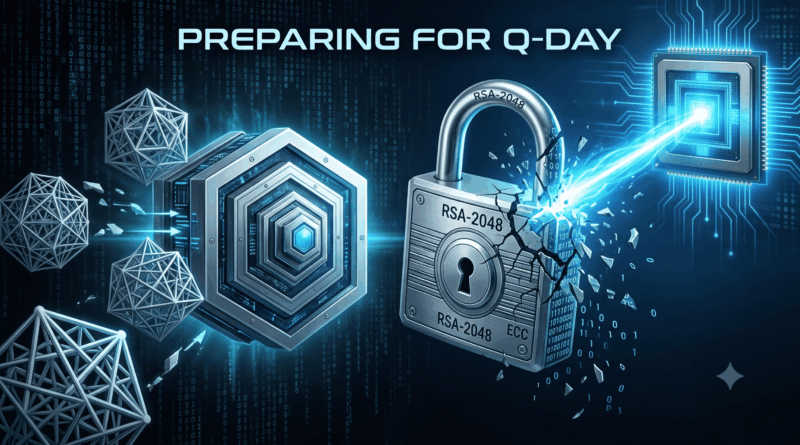
When a cryptographically relevant quantum computer (CRQC) becomes operational—an event colloquially referred to as “Q-Day”—classical asymmetric algorithms will be rendered insecure. A quantum threat actor will be able to forge digital signatures, decrypt past and present communications, and impersonate trusted servers globally.
The Immediate Threat: “Harvest Now, Decrypt Later”
A common misconception is that post-quantum cryptography is a distant concern that can be deferred until quantum hardware fully matures. This assumption ignores a current nation-state espionage strategy known as Harvest Now, Decrypt Later (HNDL).
Sophisticated threat actors are currently intercepting and storing vast quantities of encrypted data traffic passing across international fiber-optic cables, cloud storage networks, and government communication channels. While attackers cannot read this data today, they are storing the ciphertext in long-term data repositories. The moment a fault-tolerant quantum computer becomes functional, attackers will run Shor’s Algorithm against stored key exchanges, decrypting decades of sensitive national security data, industrial trade secrets, personal health records, and corporate intellectual property.
Consequently, data that must remain confidential for 10, 20, or 30 years is already compromised if protected solely by classical public-key algorithms.
NIST Standardization and the New Cryptographic Primitive Standards
Recognizing this threat, the National Institute of Standards and Technology (NIST) initiated a global evaluation process to select and standardize quantum-resistant cryptographic algorithms. The primary cryptographic primitives selected rely on Lattice-Based Cryptography, which grounds security in the computational hardness of high-dimensional geometric lattice problems (such as the Learning With Errors (LWE) problem) that remain intractable for both classical and quantum architectures:
-
ML-KEM (Module-Lattice-Based Key-Encapsulation Mechanism, originally Kyber): Designated as the primary standard for general encryption and secure session key establishment (replacing RSA key exchange and Elliptic Curve Diffie-Hellman).
-
ML-DSA (Module-Lattice-Based Digital Signature Algorithm, originally Dilithium): Selected as the primary standard for general-purpose digital signatures and identity verification.
-
SLH-DSA (Stateless Hash-Based Digital Signature Algorithm, originally SPHINCS+): Standardized as a secondary digital signature framework reliant entirely on collision-resistant hash functions, providing a secure fallback in the event that future mathematical breakthroughs compromise lattice assumptions.
Symmetric key encryption algorithms (such as AES-256) are less impacted by Shor’s Algorithm. While Grover’s Algorithm provides a quantum speedup for searching unstructured databases, it only reduces the effective security strength of AES by half. Consequently, AES-256 provides robust quantum resistance simply by maintaining large key lengths.
Enterprise Action Plan: Building Cryptographic Agility
Transitioning an organization’s digital infrastructure to post-quantum standards is an enormous engineering task, far exceeding the scale of historical migrations like Y2K or the transition from SHA-1 to SHA-256. Achieving quantum resilience requires executing a structured migration methodology:
-
Cryptographic Discovery and Inventory: Organizations must deploy automated discovery tools to scan source code repositories, network protocols, compiled software binaries, database stores, and cloud configurations to catalog every instance of cryptographic usage. Organizations cannot protect keys and certificates they do not know exist.
-
Prioritizing Data and Infrastructure Assets: High-value data with long-term sensitivity (such as financial records, citizen identities, and proprietary source code) must be prioritized for immediate PQC migration to mitigate HNDL risks.
-
Implementing Cryptographic Agility: Security engineering teams must decouple cryptographic implementations from underlying application code. By utilizing abstraction layers and dynamic cryptographic libraries, organizations can swap cryptographic algorithms via configuration files without refactoring core software logic.
-
Deploying Hybrid Cryptographic Schemes: During the transition phase, organizations should implement hybrid schemes that combine a classical algorithm (like ECDH) alongside a post-quantum algorithm (like ML-KEM) within the same network session. This ensures that even if an unproven PQC algorithm exhibits a structural vulnerability, the security layer maintains at least the baseline protection of classical standards.
Cryptographic migration is an active operational requirement. Establishing quantum agility today is the only path to ensuring data sovereignty and network integrity in the upcoming quantum era.
